In a bold assertion rooted in both legal tradition and ancestral heritage, Benjamin Narvaez Garcia has stepped into the public eye as the newly appointed Asset Manager and Administrator of the Acopiado Estate and Commodities. More than just a managerial role, Garcia’s position reawakens a decades-old legal and historical debate that challenges the very concept of land ownership in the Philippines.
What began as an academic thesis at the University of Asia and the Pacific (UA&P), titled “Property Ownership and the Banking System in the Philippines,” has transformed into a potentially explosive legal crusade. Garcia claims that the Acopiado Estate holds the only valid deed to the entire Philippine Archipelago — a document known as Original Certificate of Title (O.C.T.) No. 01-4.
A Title Lost to Time — and Law
Unlike any ordinary land title, O.C.T. No. 01-4 allegedly traces back to a Spanish Deed dated January 7, 1864, reaffirmed through a judicial decision under Cadastral Act No. 2259 on March 14, 1914. The land, once sold in 1913 by Don Hermogenes A. Rodriguez and Don Miguel A. Rodriguez, was transferred through an absolute sale to their nephew Don Gregorio Madrigal Acopiado and his wife Doña Maria Carmella Sarmento Madrigal.
Garcia maintains that this title, registered under what was then Decree No. 297 and later reaffirmed by Royal Decree 01-4, encompasses all Philippine islands from Batanes to the Sabah Islets. The legal basis? A civil case — LRC/Civil Case No. 3957-P — which, according to Garcia, affirms the estate’s claim over the archipelago.
Challenging the Torrens System
Central to Garcia’s position is his assertion that the Torrens System — the government’s land titling system — has been compromised. He states that all other land titles from O.C.T. No. 1 to No. 100,000 are “null and void,” lacking both origin and bankability. Only O.C.T. No. 01-4, he claims, has a legitimate foundation in law.
“The measurement of land under the Torrens System must correlate to measurable earth areas and transparent water bodies like rivers and oceans,” Garcia explains, arguing that this alignment has been historically overlooked, misapplied, or politically manipulated.
A Private Archipelago?
Perhaps the most controversial claim from Garcia is the outright rejection of the notion of “public land” in the Philippines. He argues that since the archipelago was registered as private property in 1914, subsequent public land laws — including the 1935 Commonwealth Act No. 141 — are unconstitutional. This claim, if proven, could have seismic implications for land reform, indigenous rights, and national sovereignty.
He further connects the estate’s historical narrative to modern geopolitical issues, such as the West Philippine Sea dispute. Garcia believes the Philippines’ legal position would be better served if raised at the International Court of Justice, citing longstanding international law principles dating back to February 4, 1972.
Interrupted by History
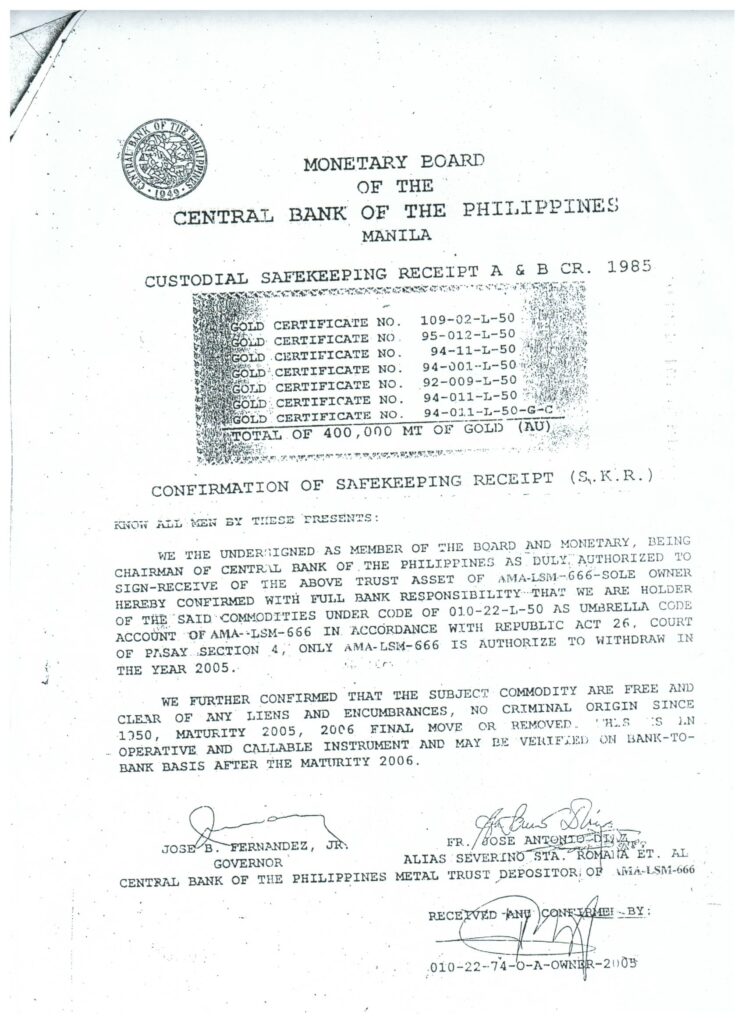
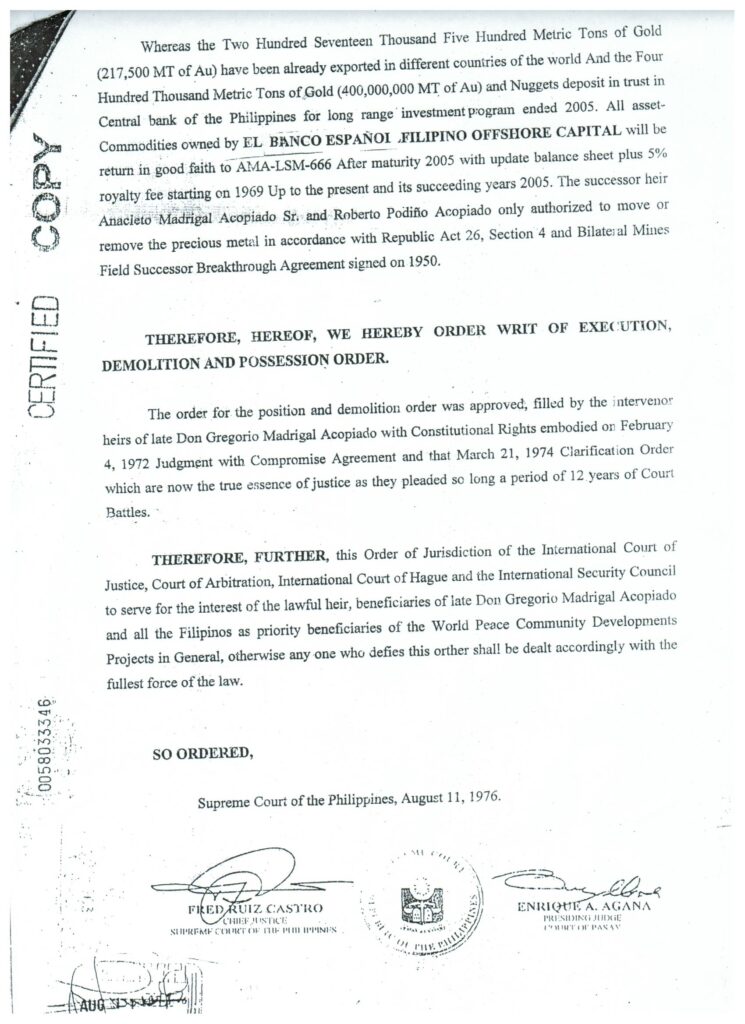
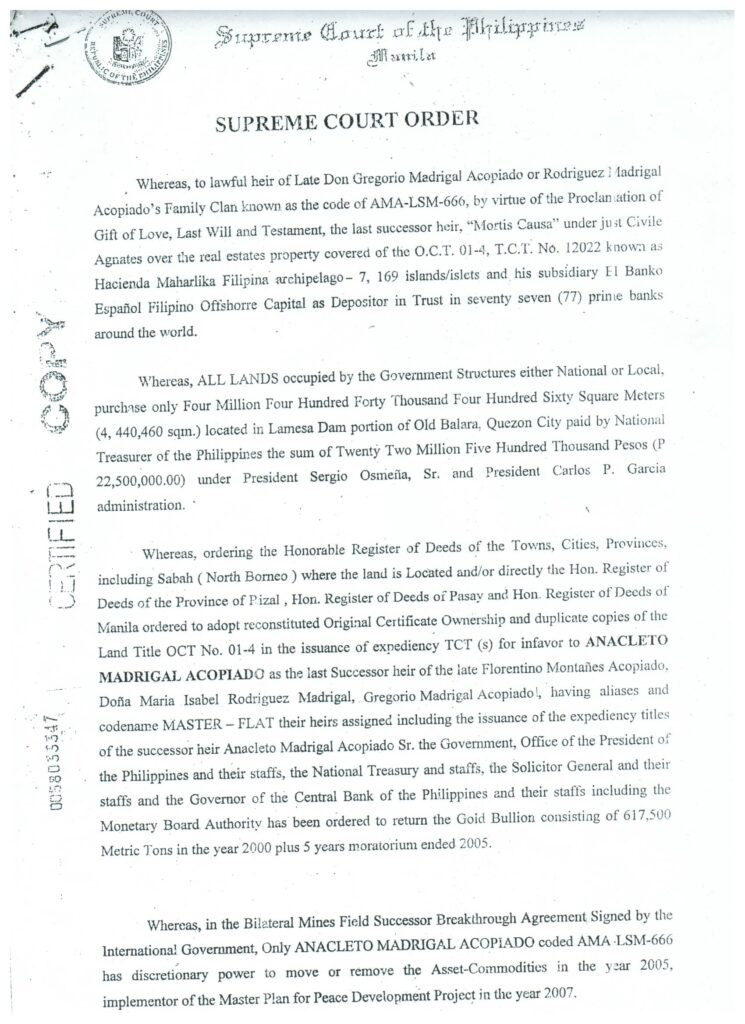
The saga of the Acopiado estate has not been without obstacles. According to Garcia, a 1975 writ of execution affirming the estate’s rights was never enforced due to the declaration of Martial Law in 1972. Since then, multiple Supreme Court orders and compromise agreements have upheld the legitimacy of O.C.T. No. 01-4, yet the estate has seen no restitution.
Further complicating matters are the deaths of Don Anacleto Madrigal Acopiado, Sr. in 1994, and his successor Roberto P.M. Acopiado in 2014. Administration of the estate has since passed to Roberto’s widow, Jocelyn T. Acopiado, and their children — all under the supervision of Garcia via an Asset Management Agreement.
A Case for the Courts — and History Books
Whether Garcia’s assertions will hold up in court remains to be seen. Still, his conviction is unwavering: “There is no public land under any Philippine Constitution,” he states, citing protections from retroactive legislation under the 1935, 1973, and 1987 charters.
Garcia’s efforts to revive the Acopiado Estate’s claims aren’t just a legal endeavor. They are a call to revisit a forgotten narrative — one buried beneath decades of political change, legal reform, and historical neglect. For now, O.C.T. No. 01-4 stands not just as a title, but as a symbol of a story that refuses to be forgotten.#