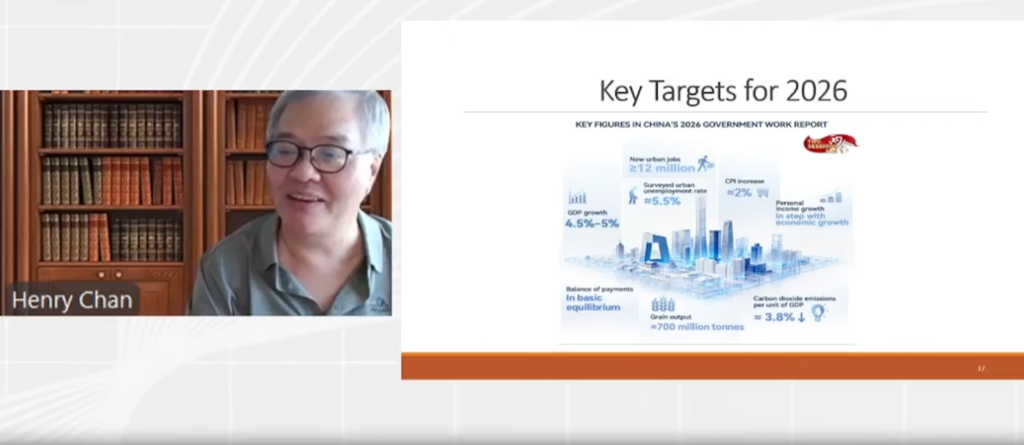
In a move signaling a decisive shift in its economic paradigm, China has formally approved the 15th Five-Year Plan (FYP) for 2026-2030 during the recent “Two Sessions”—the annual meetings of the National People’s Congress (NPC) and the Chinese People’s Political Consultative Conference (CPPCC). The new roadmap abandons the traditional growth model reliant on infrastructure investment and debt in favor of a “technology-heavy, self-sustaining model” driven by “new quality productive forces.”
According to Dr. Li Zhi, Assistant Dean of the China Institute for Development Planning at Tsinghua University, the plan represents a transition from a phase of “sowing seeds” in innovation during the 14th FYP to one of “blooming and bearing fruit.” He emphasized that the strategy is not a return to a Soviet-style command economy but a “dynamic grand strategic design” refined through scientific methods and public input, including over 3 million online suggestions.
Technology at the Core: From ‘1 to 100’ to ‘0 to 1’
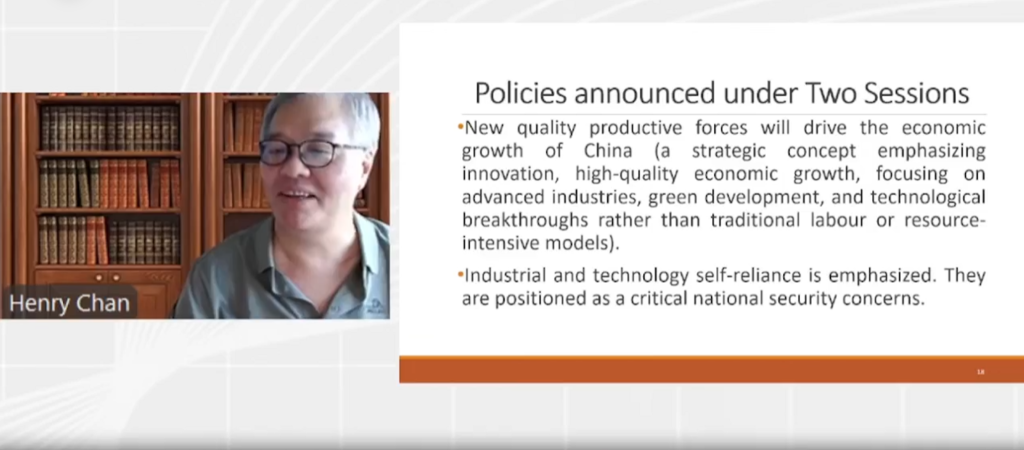
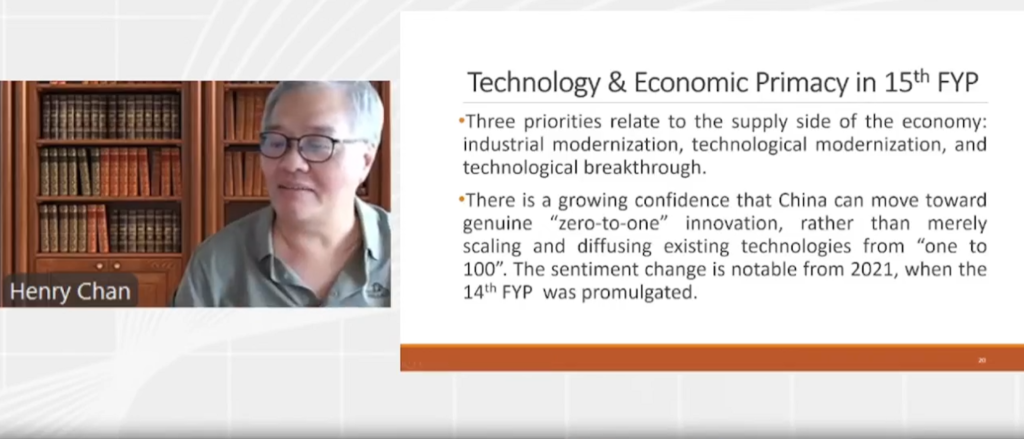
The 15th FYP places an unprecedented emphasis on technological self-reliance, framed explicitly as a critical national security concern. Analysis of the Two Sessions indicates a growing national confidence in achieving genuine “zero-to-one” innovation—creating entirely new industries—rather than merely scaling existing technologies.
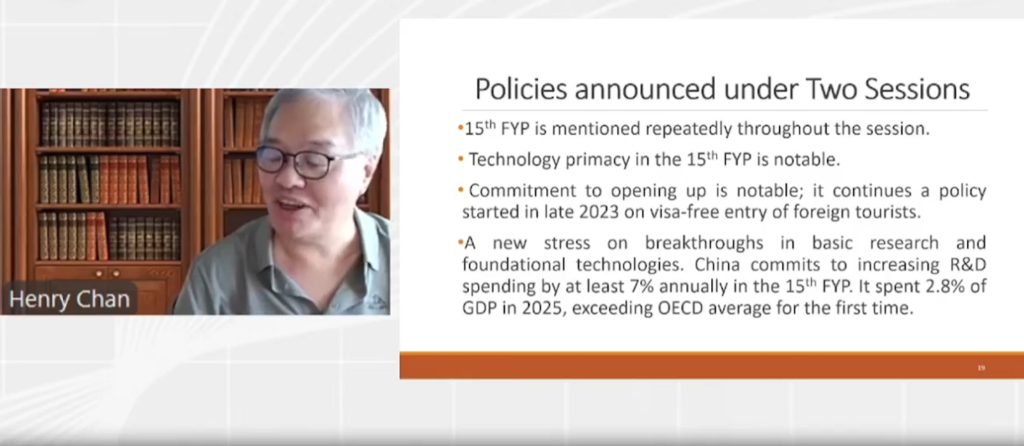
Henry Chan, in a detailed brief on the policy outcomes, notes that China has committed to increasing Research & Development (R&D) spending by at least 7% annually over the next five years. Having already spent 2.8% of GDP on R&D in 2025—surpassing the OECD average for the first time—the country is doubling down on basic research and foundational technologies.
The strategic focus aligns with findings from the Australian Strategic Policy Institute (ASPI) Critical Technology Tracker. According to the data cited in policy reviews, China already leads the world in 57 out of 64 critical technology areas tracked in 2023. By the expanded 2025 dataset, that leadership grew to 66 areas. While developed countries still hold advantages in foundational “legacy” technologies like advanced semiconductors and jet engines, China is racing ahead in hypersonics, AI, quantum computing, and green energy systems.
“An Invitation Letter to the World”: Opportunities for the Global South
Despite rising geopolitical tensions, the 15th FYP dedicates an entire chapter to “expanding high-standard opening up.” Dr. Li Zhi characterized the plan not merely as a domestic blueprint but as “an invitation letter to the world,” particularly for developing nations in Asia and Africa.
1. Industrial Upgrading and Regional Integration:
China envisions co-development with regional partners. “Building a modern industrial system doesn’t mean building all industries for ourselves,” Dr. Li stated. He cited the China-Laos Railway as a model, where mineral and agricultural exports have boosted the local economy. Looking ahead, Chinese automation and industrial robotics could help integrate and upgrade factories in Vietnam and Thailand, while collaborative solutions—such as combining Chinese robotics with South Korean smart care systems—are proposed to address the shared challenge of aging populations.
2. The “Upgraded” Belt and Road Initiative (BRI):
The next phase of the BRI will focus on “high-quality” development and green technology transfer. Dr. Li highlighted projects where China’s experience in building solar plants on deserts and Gobi is being exported to Egypt, and wind projects in Kenya are providing “cheaper and more stable green electricity.” This positions China’s green technology as a global public good, turning domestic environmental goals into international economic opportunities.
3. Market Access and “Dinner Table” Economics:
With a domestic market of 1.4 billion people and a rapidly growing middle class, China plans to implement zero-tariff treatment for more developing countries. This opens the door for high-value agricultural exports—such as Thai durians, Kenyan avocados, and Ethiopian coffee—to enter the Chinese market at lower costs, offering tangible revenue for farmers and exporters across Asia and Africa.
Geopolitical Context: A Call for Re-engagement
The release of the plan comes amid significant global tectonic shifts. A position paper from the Association of Philippines for China Studies (APCS) argues that the Philippines is currently “caught between the rock of Western hegemony and the place of the consolidating new world multipolar order.”
The paper warns that Manila’s recent pivot toward the U.S.—including the acceptance of additional military bases and the cancellation of cooperation projects with China—has led to supply crises and mounting debt. It urges the Philippines to “start re-engaging totally and fully” with China to ride the wave of the 15th FYP’s opportunities, framing the economic plan as a path back to growth and prosperity amid the “collapse of Dollar hegemony” and the rise of a multipolar global architecture.
As China embarks on the 15th FYP, the message from Beijing is clear: the country intends to lead in defining the next generation of industrial revolution. By coupling aggressive technological goals with a promise of expanded market access, China is positioning itself as the engine of global growth and stability. For developing nations, the message, as summarized by Dr. Li, is to “get in the fast-going train of China’s development and share the opportunity.”#