

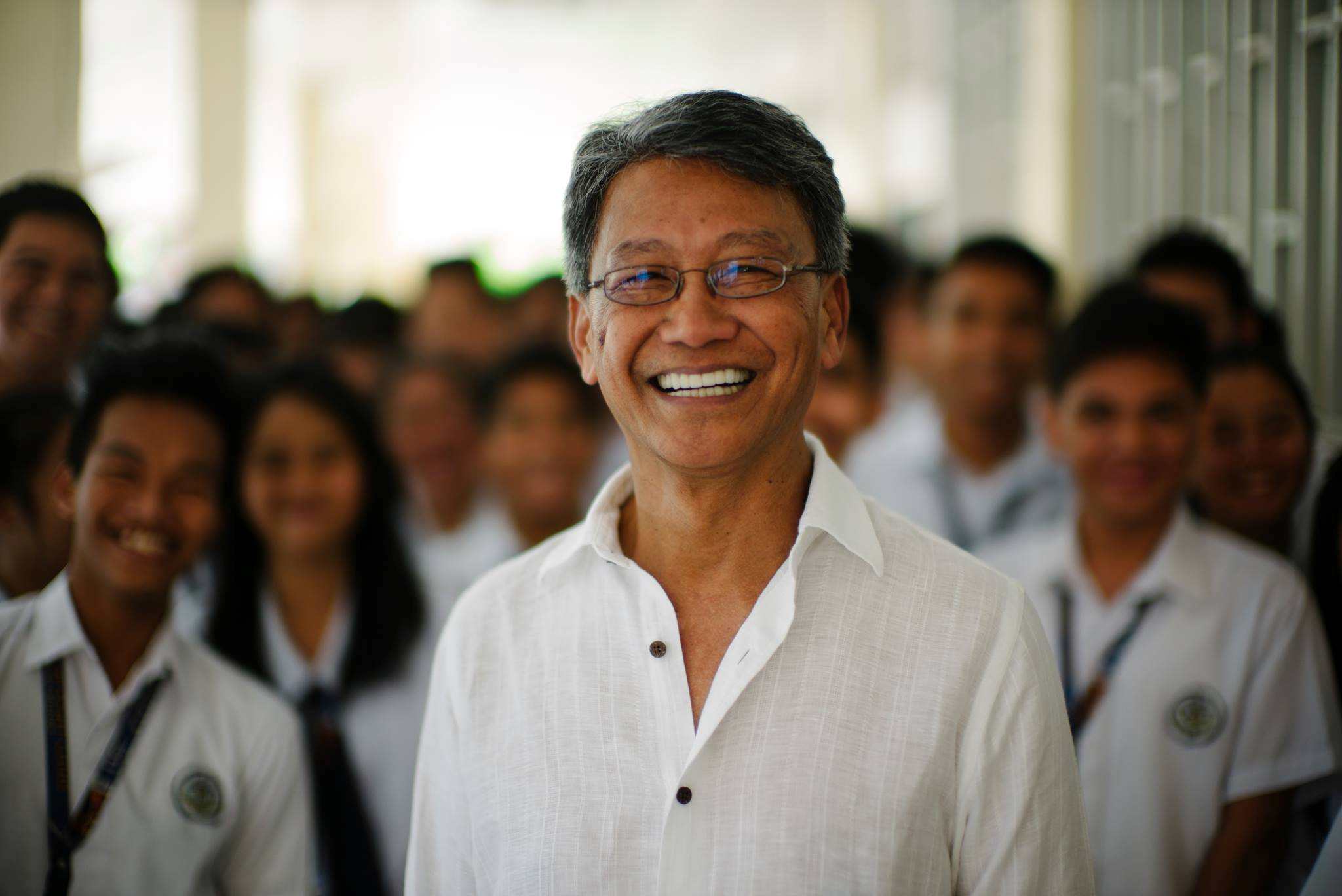
In the hushed reverence of a university gymnasium in Cagayan de Oro, a man who helped shape the digital world stands before a sea of eager, young faces. His title is Doctor of Science, Honoris Causa. His attire is academic regalia. But his story—the one he is about to share—is written in the soil of a rice farm, etched onto silicon wafers in Silicon Valley, and fueled by a singular, unwavering philosophy: “It’s OK to fail as long as you get up and continue to fight for your dreams.”


This is the story of Engr. Diosdado “Dado” Banatao. To Forbes, he is the “Benevolent Disruptor,” the engineer whose innovations made personal computers smaller, more powerful, and affordable for millions. To the tech world, he is a legendary figure with a string of industry “firsts” to his name. But to the Class of 2019 at Xavier University – Ateneo de Cagayan, and to anyone who hears his journey, he is first and foremost the son of a rice farmer from Barrio Malabbac in Iguig, Cagayan.

His narrative begins not with circuit boards, but with bamboo sticks. Twenty of them, to be precise—his first math tools in a humble elementary school. His father, a high school graduate who worked as an overseas worker in Guam for seven years, and his mother, Nanang Rosita, who ran a sari-sari store while single-handedly raising the family, held a non-negotiable belief: education was the key to a better life. This was the first seed planted.
Spotted by his grade school principal, a grand aunt he called Mama Osa, young Dado’s potential was recognized early. She propelled him from his barrio to Ateneo de Tuguegarao High School. At twelve, he found himself alone in a small boarding house, a world away from the familiar rhythms of farm life. The loneliness was palpable, but it was here that the Jesuit ideal of teaching students how to think took root. “They challenged us and emphasized the critical thinking process,” Banatao recalls. This, coupled with his innate prowess in mathematics, became his compass.
That compass pointed toward Engineering at Mapua Institute of Technology, where a relentless work ethic saw him solving every problem in his textbooks—not once, but twice. Even a Cum Laude finish in Electrical Engineering did not shield him from the anxiety of poor harvests, when his father had to borrow money to keep him in Manila. Failure was not an abstract concept; it was a looming shadow over the family’s livelihood. Yet, they persisted.
His early career path meandered—a near-miss with becoming a PAL pilot, a fateful job application from a professor for Boeing in the USA. On a senior captain’s advice, he took a chance. In April 1968, he immigrated to Seattle, a decision that would alter the trajectory of technology.
At Stanford University, in the heart of the nascent Silicon Valley, the intimidation returned. The barrio boy was again an outsider. But the familiar Jesuit ethos of disciplined thinking served as his anchor. He forged a unique path, blending electrical engineering with emerging computer science, driven by a “natural engineer’s” obsession.
Banatao’s career is a chronology of quiet revolutions. At National Semiconductors and beyond, he was at the epicenter of the computing explosion:
The first single-chip, 16-bit microprocessor-based calculator for Commodore, which dethroned giants like HP and Texas Instruments.
The first system logic chipset for the iconic IBM PC-AT at Chips and Technologies—an innovation that fundamentally shrank and democratized the personal computer.
Later, as a venture capitalist with Tallwood Venture Capital, his Midas touch extended to funding the first GPS chipset, hard disk controllers, and graphics accelerators. His was not just technical genius, but a market-centric vision: “My goal is always to make people’s lives better.”
For Banatao, success is empty without significance. In the early 1990s, he turned his focus homeward. Through the Philippine Development Foundation (PhilDev), he champions the pillars of Education, Entrepreneurship, and Innovation. He has lobbied for government scholarships, forged research ties between Philippine and U.S. universities, and tirelessly worked to build a culture of tech-based entrepreneurship in the Philippines.
His giving is profoundly personal. It started with bringing a computer center to his little barrio school. It continues with scholarships for STEM students, both in the Philippines and among FilAms in California. The legacy he wants is clear: “to be remembered as a good person first, an engineer second.”
Dado Banatao’s journey from Cagayan Valley to Silicon Valley is a masterclass in human potential. It is a story devoid of inherited privilege, built instead on intellectual rigor, the solid values of hard work and perseverance instilled by parents who “lived by the soil,” and an unwavering faith in the power of getting back up.
As he told the graduates, his message resonates far beyond the gymnasium walls. In a world obsessed with overnight success and terrified of missteps, Banatao offers a saner, sturdier formula: Stay focused. Never give up. Embrace failure as a lesson, not an end. His life is testament to the fact that true fortune resides not in wealth alone, but in “fortitude, family, and faith.”
The bamboo sticks of Malabbac have long since been replaced by nanoscale transistors. But the strength, flexibility, and resilience they represent—the very spirit of the Filipino farmer and the global innovator—live on in Dado Banatao. And his story insists that within every dream, no matter how humble its origins, lies the power to reshape the world. You just have to get up, and continue to fight.#


