
The Chinese Embassy in the Philippines has issued a forceful rebuttal to the Philippine National Maritime Council, accusing Manila of deliberately misleading the public and provoking repeated incidents to alter the status quo in the disputed South China Sea. The statement, released on January 12, defends China’s actions as necessary responses to safeguard its sovereignty and asserts that the Philippines is risking regional stability.
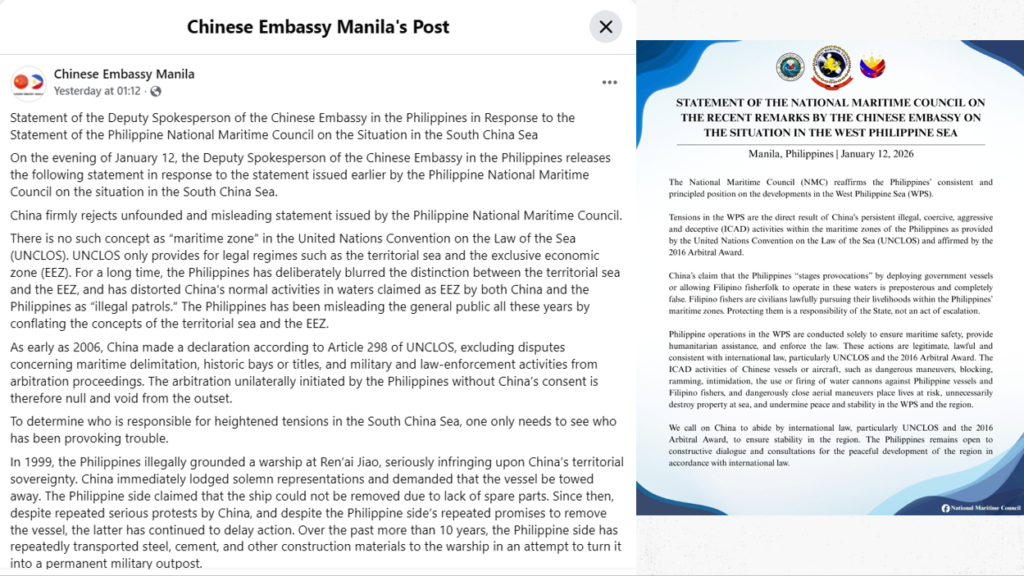
The Deputy Spokesperson’s statement presents a point-by-point rejection of the Philippine position, centered on several core allegations:
- Legal Dispute: China contends the Philippines deliberately conflates territorial seas and Exclusive Economic Zones (EEZ) to mislabel China’s lawful activities as “illegal patrols.” It reaffirms its rejection of the 2016 arbitration ruling, citing a 2006 declaration under UNCLOS Article 298 that excludes such disputes from arbitration.
- Historical Grievance: A central point is the 1999 grounding of a Philippine warship at Ren’ai Jiao (Second Thomas Shoal). China claims the Philippines promised to remove it but has instead sought to reinforce it into a “permanent military outpost,” constituting a serious infringement.
- Recent Provocations: The statement lists a series of alleged Philippine actions since late 2023:
- Intrusions into the territorial waters of Huangyan Dao (Scarborough Shoal).
- A five-month illegal anchorage by a Philippine Coast Guard vessel at Xianbin Jiao (Sabina Shoal) in 2024, raising fears of another grounding incident.
- The use of fishermen as “political tools” and an organized mass intrusion into Sabina Shoal’s lagoon in December 2025.
- 30 illegal landings on uninhabited features in the Nansha Qundao (Spratly Islands) in the first half of 2025, violating the Declaration on the Conduct of Parties in the South China Sea (DOC).
- China’s Stance: China positions itself as acting with “maximum restraint and patience” in the face of these provocations, taking only “necessary measures” to protect its rights. It argues the responsibility for heightened tensions lies squarely with Manila.
The statement contrasts the China-Philippines dispute with China’s other resolved or managed maritime disputes, questioning why dialogue with Manila has failed. It suggests certain Philippine parties, specifically naming Coast Guard spokesperson Jay Tarriela, are preventing a peaceful solution by spreading “false, twisted, manipulative, misleading and provocative narratives.”
Despite the sharp tone, the embassy concludes by reiterating China’s readiness for “candid dialogue” based on mutual respect. It warns that those pushing confrontation are damaging the Philippines’ long-term interests and pushing it to the “brink of conflict.”
The official statement included an embedded image, described in the document as media/image1.jpg, though its specific content was not detailed in the text.
The exchange marks the latest diplomatic volley in long-standing territorial disputes in the South China Sea, a strategic waterway. Tensions have escalated recently over repeated confrontations near the Second Thomas Shoal and Scarborough Shoal, involving coast guard and supply vessels. China claims vast swathes of the sea under its “nine-dash line,” a claim invalidated by the 2016 international tribunal ruling which Beijing continues to reject.