

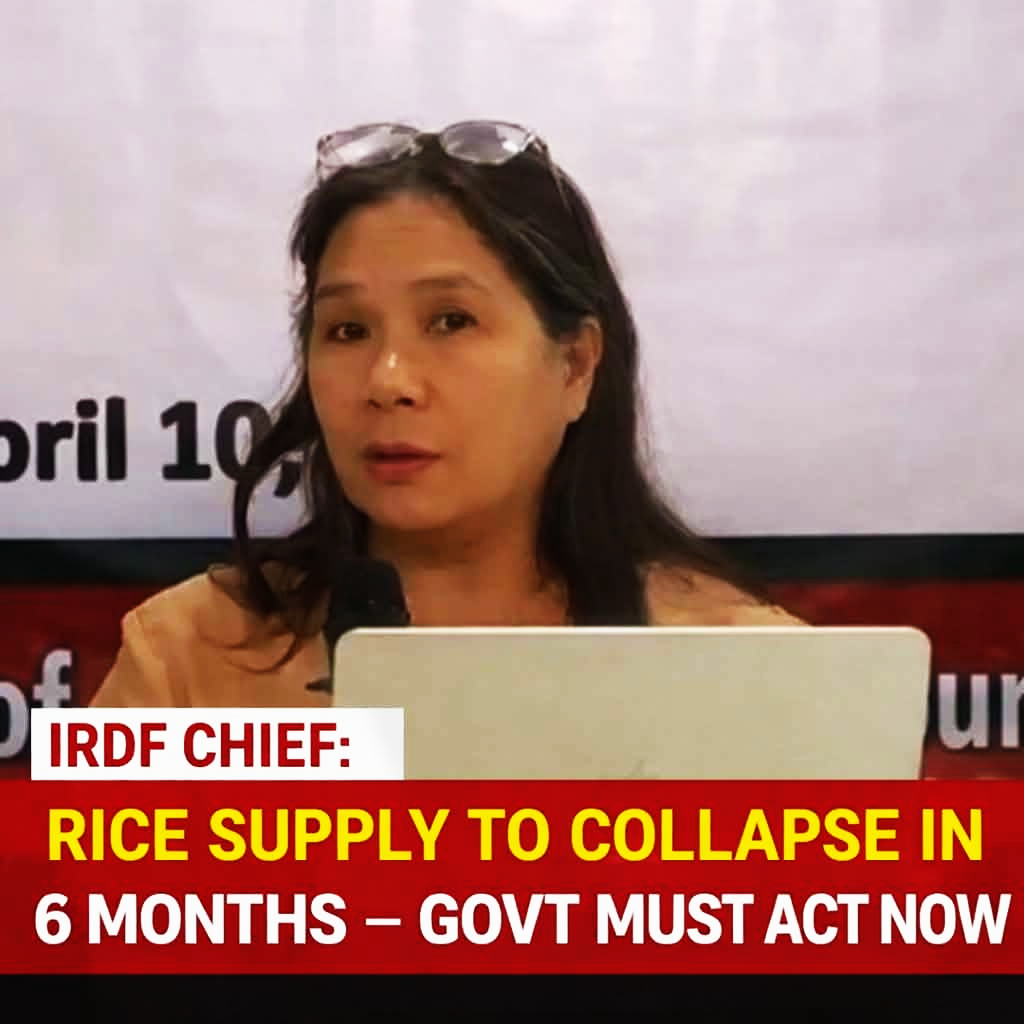
NFA buffer stock only 100,000 MT vs. needed 300,000 MT to lower prices; farmers can’t afford fertilizer as prices soar 46%
The Philippines is facing a severe rice crisis that could leave millions of Filipino families with only one meal a day within the next six months unless the government takes immediate, decisive action, warned Arze Glipo, Executive Director of the Institute for Rural Development and Research Foundation (IRDF).

Speaking at a recent forum, Glipo delivered an urgent call for the government to reinstate an active market intervention role — starting with raising the National Food Authority’s (NFA) buying price for palay, providing emergency cash aid of at least P15,000 per farmer, and suspending oil taxes to prevent a total collapse of local food production.
“This is not a situation that will change in the next 2-3 years,” Glipo said. “Kailangan natin kumilos ngayon.”
Critical Buffer Stock Deficit
Glipo revealed that the NFA currently holds only 2 million bags of rice — equivalent to roughly 100,000 metric tons (MT). However, to stabilize the current market price of rice, which has already climbed to P60–P75 per kilo, and bring it down to a more manageable P45–P50, the government would need to release 300,000 MT into the market.
“Ang mayroon lang siya ay 100,000 MT,” Glipo emphasized. “In order to regulate ang presyo, kailangan maglabas siya ng 300,000 MT ng bigas.”
Under the Rice Tariffication Law, the NFA’s role has been reduced to maintaining a mere 15-day buffer stock — intended only for calamity response, not for price stabilization or supply intervention during market crises. Glipo noted that other countries maintain 60 to 120 days of buffer stock, with some even keeping a one-year supply.

Fertilizer Price Spike to Slash Production by 5–6 Million MT
Glipo cited data from agricultural expert Dr. Ted Mendoza, warning that fertilizer prices have surged by 46% since early March, making inputs unaffordable for the average farmer. As a result, many farmers have stopped applying urea and complete fertilizer altogether.
“Sabi niya kung hindi naglalagay ng fertilizer, babagsak ng 5M metric tons,” Glipo said. “Bakit hindi maglalagay? Taas ba naman ang presyo ngayon.”
The projected drop in palay production is estimated at 5 to 6 million MT. Glipo warned that this decline will directly reduce rice supply, driving prices even higher. The problem is compounded by rising fuel costs, which affect mechanized harvesting, irrigation, and transport.
Government Must Buy Palay at P25–P27, Not P21
To rebuild depleted stocks, Glipo urged the NFA Council to immediately issue a resolution raising the government’s buying price for fresh palay. Currently, the NFA buys at P21 per kilo (dry) and P19 (wet) — far below the P25–P27 offered by private traders.
“Para makontrol niya ang presyo ng bigas, dapat mayroon siyang palay. Para makapamili siya ng palay, kailangan itaas niya ang presyo ng pamimili niya,” Glipo stressed.
She recommended an emergency procurement of at least 200,000 MT of palay immediately, which, combined with existing stocks, would allow the government to release 300,000 MT of rice into the market at lower prices.
P30 Billion Cash Aid Needed — Just 10% of Emergency Fund
Glipo called for a minimum of P15,000 in cash assistance per farmer — up from the previously proposed P10,000 — to help them cope with rising fertilizer costs and recover from past losses when palay buying prices dropped to as low as P12 per kilo.
“Makatarungan po yun,” she said. “Kung gawin pa natin P15,000, that would only be P30 billion.”
She noted that the Department of Budget and Management has already identified P230 billion in available emergency funds. The proposed P30 billion represents just 10% of that amount — a small price, she argued, to secure the nation’s food supply.
“Magkano ang emergency fund ngayon? P230B. That would only be 10% of the emergency fund that will go to securing our food supply,” Glipo said.
Suspend Oil Taxes, Provide Fuel Vouchers for Farmers and Fisherfolk
Glipo also called for the immediate suspension of excise taxes and VAT on fuel, along with the provision of oil vouchers for farmers and fisherfolk. She painted a grim picture of the fishing sector: a fisherman now spends around P700 on diesel for a single trip but earns only P250–P300.
“So wala na, lalabas at tataas din ang isda kasabay ng bigas. Ano nang kakainin ng ating mamamayan?” she asked.
Without government relief, she warned that fish prices will rise in tandem with rice, leaving poor families with no affordable protein source.
Visible Signs of Hunger: Senior Citizens Piling Up Before Dawn
Glipo shared firsthand observations of the growing hunger crisis, noting that she had seen senior citizens lining up as early as dawn — some eating only once a day.
“Nakita na natin may pumipilang senior citizens… Bakit sila pumila madaling araw? Tatlong beses? Kumain nalang sila ng isang beses? Hindi ba kalunos-lunos yun?” she said.
She stressed that individual cooperatives and farmers cannot be left to solve the rice security problem on their own. “Problema po yun ng gobyerno. Kailangan pakilusin na niya ang kanyang makinarya.”
Reject Neoliberal Policies, Restore Government Power
Glipo squarely blamed decades of neoliberal policies — including the Rice Tariffication Law, Oil Deregulation Law, and the removal of subsidies and import restrictions — for weakening the government’s capacity to respond to the current crisis.
“Ito ang pagbibigay ng poder sa merkado at nawawalan ng poder ang ating pamahalaan,” she said. “Talaga namang naninindigan kami na mali ang neoliberal policy.”
She argued that the government must prioritize food security over big capital and infrastructure projects, and push for alternative pathways such as solar-powered irrigation systems, renewable energy for rice milling and mechanical drying, and a strategic rice reserve of up to 60 days.
“This is not a rice security act na ang priority natin ay support domestic palay production, strategic rice reserve up to 60 days, regulate importation. Regulate, huwag ilagay sa mga importers ang pag-i-import,” Glipo emphasized.
Global Context Worsens Local Crisis
Glipo noted that the crisis is global. Major rice exporters like Vietnam, India, and Thailand may not be able to immediately ramp up exports due to rising logistical costs and supply chain disruptions. The ongoing Russia-Ukraine war and continued global tensions mean that food prices will remain volatile for the foreseeable future.
“Kaya we have to secure our food, go into alternative pathways,” she said.
Call for an Emergency Act for Rice
Drawing a parallel to the Energy Emergency Act, Glipo proposed the passage of an Emergency Act for Rice that would authorize the government to:
- Raise palay buying prices to P25–P27
- Procure at least 200,000 MT immediately
- Release rice at subsidized prices to counter market rates of P60–P70
- Provide targeted cash and fuel assistance to farmers and fisherfolk
“Yun lang ang nakikita naming solusyon,” she concluded.
Conclusion: Averting a Hunger Catastrophe
Glipo warned that without urgent action — within weeks, not months — the country will face a food supply collapse that will hit the poorest and most vulnerable sectors hardest. She urged the government to act now, mobilize the NFA, release emergency funds, and fundamentally reverse the policies that have left the nation’s food system dangerously exposed.
“Kung hindi natin maabot, maraming magugutom,” she said. “We do not want to see our families subsisting on once-a-day meal.”#


