
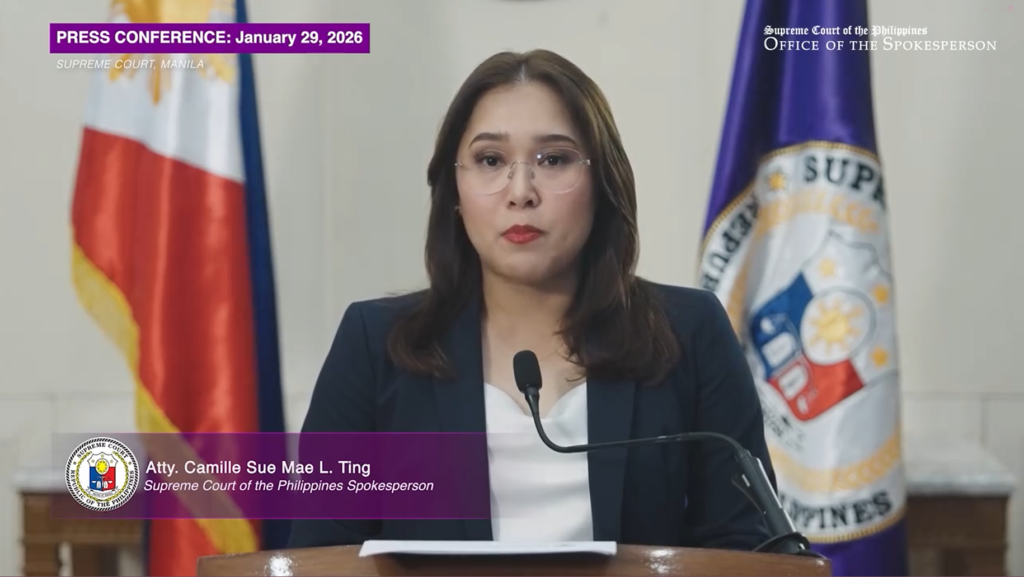
The Supreme Court of the Philippines has decisively and finally rejected the House of Representatives’ attempt to revive an impeachment case against Vice President Sara Z. Duterte. In a press conference on January 29, 2026, Court Spokesperson Atty. Camille Sue Mae L. Ting announced the en banc’s unanimous denial of the House’s motion for reconsideration, affirming its July 2025 ruling that the fourth impeachment complaint was constitutionally barred. The Court issued significant clarifications on impeachment procedures, including the definition of “session days” and the distinct processes for filing complaints.
Finality and One-Year Bar Upheld:
Spokesperson Ting stated the Court “denied with finality” the House’s motion, affirming that the fourth impeachment complaint transmitted on February 5, 2025, was barred by the constitutional one-year ban on filing multiple impeachment complaints against the same official. “No further pleadings will be allowed,” she emphasized.
Definition of “Session Days” Clarified:
The Court ruled that for impeachment purposes, a “session day” is not a legislative session day but a calendar day on which the House holds a plenary session. This interpretation was central to the finding that the first three complaints were not placed on the order of business within the required 10-session-day period, rendering them inactive.
Two Modes of Impeachment Detailed:
Ting elaborated on the Court’s distinction between the two constitutional modes of initiation:
- First Mode (Regular Process): Involves filing a verified complaint, referral to the Committee on Justice for evaluation, and emphasizes “institutional screening.”
- Second Mode (Direct Initiative): Requires a verified complaint endorsed by at least one-third of House members, which “immediately initiates impeachment proceedings” without mandatory committee review, reflecting a pre-existing consensus.
House Rules and Committee Referral:
While affirming the House’s power to make its own impeachment rules, the Court clarified that under current House rules, even a complaint filed via the second mode (by one-third endorsement) may optionally be referred to the Committee on Justice—but only to verify signatures, confirm evidence exists, and consolidate complaints, not to block it.
Due Process is “Sui Generis” in Impeachment:
The Court affirmed that due process applies but is unique (“sui generis”) to impeachment. For the second mode, due process is satisfied if: grounds are constitutional, House rules are followed, and all endorsing members receive the complaint and evidence. The “full-blown trial” occurs in the Senate.
Operative Fact Doctrine Not Applicable:
In response to a question, Ting explained the doctrine of operative fact—which sometimes validates effects of an unconstitutional act—does not apply here. “It cannot be used to try to justify an unconstitutional act,” she said, referring to the barred fourth complaint.
Impact on Future Complaints:
Ting confirmed that the one-year bar period, which prevents new complaints, began from the transmission of the unconstitutional fourth articles on February 5, 2025. This ruling sets the precedent for all ongoing and future impeachment proceedings in the House.
The voting remained unanimous among participating justices. Justices Caguioa and Singh did not take part.
- The ruling builds upon but expands the precedent set in the Gutierrez vs. House case, particularly on when an impeachment is “initiated.”
- On other matters, Ting stated the Court would act on a separate petition filed by former President Rodrigo Duterte (referred to as “Zaldico” in the transcript) according to standard procedures and would await filings regarding the postponed BARM elections.
The Supreme Court’s original July 25, 2025, decision struck down the impeachment articles against Vice President Duterte, declaring the complaint unconstitutional for violating the one-year bar rule under Article XI, Section 3(5) of the 1987 Constitution. This press conference confirms that decision is now incontestable, setting a binding interpretation of impeachment procedures.#