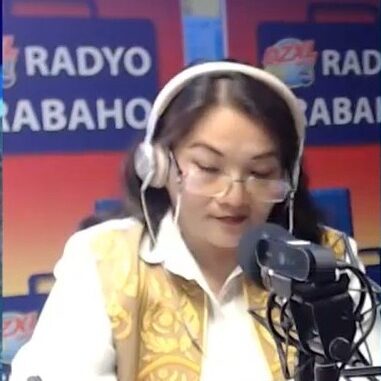
In a viral episode for Peanut Gallery Media Network, news anchor and firefighter CJ Hirro dismantles narratives to reveal the calculated strategy, human cost, and political battlefield of a decades-long communist insurgency.

In the heated political discourse of the Philippines, few terms are as weaponized or as divisive as “red-tagging.” It’s decried as a silencing tactic, a tool of persecution, and a threat to democracy itself. But in a comprehensive and explosive 68th episode of the Peanut Gallery Media Network (PGMN), award-winning anchor CJ Hirro cuts through the hysteria. Leveraging her platform not for sensation but for sober revelation, Hirro presents a chilling exposé: that the cries of “red-tagging” often mask a life-or-death struggle involving terrorist designation, a sophisticated rebel ecosystem, and a psychological war for the hearts and minds of the poorest Filipinos.

The Anchor and the Argument
CJ Hirro, a prominent figure who transitioned from pageant glory to hard-hitting journalism and volunteer firefighting, uses her credibility to tackle the nation’s most entrenched conflict. She begins with a stark, uncontested fact: the Communist Party of the Philippines-New People’s Army (CPP-NPA), and its political wing, the National Democratic Front (NDF), are officially designated as terrorist organizations. This designation is shared by the Philippine government under the 2020 Anti-Terrorism Act and by international powers including the United States, the European Union, and Australia.


The central question of her report is this: If the parent organization is universally recognized as terrorist, why is identifying its alleged legal fronts and allies considered a dangerous, and potentially criminal, act of “red-tagging”?
Deconstructing “Red-Tagging”: From Label to Legal Front
Hirro delves into the legal definition, citing former Senator Leila de Lima’s proposed bill: “red-tagging is the labeling or portrayal of individuals, groups, or organizations as state enemies, subversives, communists, or terrorists.” The Supreme Court has called it a threat to life and liberty. On its face, it’s a powerful shield.

However, Hirro pivots to the government’s counter-narrative, articulated by the National Task Force to End Local Communist Armed Conflict (NTF-ELCAC). Their claim: they are not “red-tagging,” but “exposing the lies, the deceit… of the legal fronts or allies of the CPP-NPA.” This, the episode argues, is the core of the conflict—a battle over perception and legitimacy.
The Makabayan Bloc: Electoral Decline and Alleged Links
The episode presents a compelling data trail focused on the Makabayan bloc, a coalition of progressive party-lists including Bayan Muna, Gabriela, ACT Teachers, and Kabataan. Election data from 2010 to the present shows a stark decline in their votes, which they and their allies blame squarely on government-led “red-tagging” and the policies of former President Rodrigo Duterte.
Hirro then juxtaposes this with testimonies from former rebels who served within the CPP-NPA hierarchy. They allege, in stunning detail, that these very party-lists are not victims but integral components of the revolutionary structure. One former rebel claims Sarah Elago, a former Kabataan congresswoman, funneled her entire congressional pork barrel to the CPP-NPA. Another states that recruitment quotas for the NPA were managed through youth organizations linked to these party-lists. A former Education Secretary for the CPP-NPA Visayas committee alleges she was a founding member of a Makabayan-linked youth group.
The NPA Playbook: Extortion, Ambush, and Exploitation
The feature article highlights Hirro’s presentation of the NPA’s operational model, as confessed by former members:
- “Revolutionary Tax”/Extortion: Systematic shakedowns of businesses, politicians, and even small farmers. Tariffs are provided: P10,000 for councilors, up to P1-2 million for governors and congressmen for “permits to campaign” in NPA-influenced areas. Annual extortion income is estimated in the hundreds of millions, if not billions, of pesos.
- Strategic Provocation: Hirro references the 1971 Plaza Miranda bombing, citing a CPP directive to exploit conflict between the elite Nacionalista and Liberal parties. The goal: “If we make these two ruling parties fight, it will weaken the ruling class as a whole and hasten their downfall.” The greater the state repression, the theory went, the greater the revolutionary resistance.
- Exploitation of Indigenous Peoples (IPs): Former rebels describe deliberately agitating IP communities over ancestral domain issues, misleading them about mining and logging operations to recruit them as guides and warriors familiar with the mountainous terrain.
The International Funding Web
The episode further alleges that the insurgency is bankrolled not just by local extortion but by international networks. It points to NGOs like the Rural Missionaries of the Philippines, accused of receiving tens of millions from European donors, with funds allegedly funneled to CPP-NPA fronts. Schools for indigenous communities, like the Salugpongan schools, are presented as institutions built with foreign aid but used for rebel recruitment and propaganda, using images of poverty to secure more funding abroad.
The Human Cost: The Voices Often Silenced
Amidst the political and legal arguments, Hirro anchors the story in raw human suffering. She gives voice to former rebels who express disillusionment—“I didn’t see us helping the people”—and to the families of victims. The segment notes the estimated 40,000-43,000 deaths over 56 years, the longest-running communist insurgency in the world, including soldiers, rebels, and civilians like a four-month-old baby killed in crossfire.
A poignant challenge is posed: while human rights groups rally around activists accused of being rebels, where is the outrage, the episode asks, for the victims within the movement—the recruits, the raped, the families torn apart?
A Direct Appeal and a Stark Choice
CJ Hirro concludes with a direct address to President Ferdinand “Bongbong” Marcos Jr. She notes that while the Anti-Terrorism Council has designated the CPP-NPA-NDF as terrorists, formal proscription through the Court of Appeals remains pending. “The ball is in your hands,” she states. With three years left in his term, ending the insurgency—a task his father could not complete—would cement a legacy far beyond the drug war of his predecessor.
Conclusion: More Than a Label
“Peanut Gallery Media Network Episode 68” transcends simple partisan bickering. Under CJ Hirro’s stewardship, it becomes a forensic examination of a national wound. It argues that the “red-tagging” debate is not merely about political name-calling but is a critical front in a protracted conflict. It is a clash between a state’s duty to expose what it sees as a terrorist ecosystem and the defense of legal dissent. The episode’s power lies in its uncomfortable premise: that sometimes, behind the hysteria of a label, lies a hidden architecture of violence, recruitment, and finance that demands scrutiny, even if that scrutiny itself is the most contested battleground of all.
The final message is a sobering one: the path to peace requires looking past the convenient hysteria to confront the life-or-death truths, no matter how politically inconvenient they may be.#